Works Cited

1] Mondics, Jamie. “How to Help Someone with Depression.” Mental Health First Aid. 8 September 2018, https://www.mentalhealthfirstaid.org/external/2018/09/how-to-help-someone-with-depression/

2] National Institute of Mental Health. “Depression and College Students.” :https://www.nimh.nih.gov/health/publications/depression-and-college-students/index.shtml#pub5

3] National Institute of Mental Health. “Major Depression.” 2017, https://www.nimh.nih.gov/health/statistics/major-depression.shtml

4] National Institute of Mental Health. “Persistent Depressive Disorder (Dysthymic Disorder).” November 2017, https://www.nimh.nih.gov/health/statistics/persistent-depressive-disorder-dysthymic-disorder.shtml

5] Rosenthal, Norman. “Winter Blues.” Google Books, 2013, https://books.google.com/books?hl=en&lr=&id=-B5RLgjErTAC&oi=fnd&pg=PP2&ots=EwnM3FwKjC&sig=pdWhgw2BXJBjcJz_plwk_OUKXGU#v=onepage&q&f=false16] Shleton, Jessica. “Depression Definition and DSM-5 Diagnostic Criteria.” 18 March, 2019, https://www.psycom.net/depression-definition-dsm-5-diagnostic-criteria/#dsm-5diagnosticcriteria

Created by: Hannah Love, Meghan Richter,
Raylan Vanderau

What is Depression?


When someone is feeling sad, it doesn’t always mean that they are depressed. When someone is sad, has a lack of motivation, isn’t functioning in their daily routine, or has any of the other symptoms, for at least 2 weeks or more, they might be experiencing a depressive episode. Depression can often be described as “feeling like you’re suffocating while watching others breathe” or “only seeing the world in gray or black while other see the world in color.” Depression along with every other mental health disorder is a hard disorder to cope with alone. Confiding in others and having a social support around you can make a big difference in your recovery.


Symptoms

Seasonal Affective Disorder, Persistent Depressive Disorder, and Major Depressive Disorder all experience the following symptoms2:

Photo by Kat Jayne on Pexels.com

Persistent sad, anxious, or “empty” mood

Feelings of hopelessness, or pessimism

Irritability

Feelings of guilt, worthlessness, helplessness

Loss of interest or pleasure in hobbies and activities

Image result for depression sleep
Photo by Annie Spratt on Unsplash

Decreased energy or fatigue

Moving or talking more slowly

Feeling restless or having trouble sitting still

Difficulty concentrating, remembering, or making decisions

Photo by Life Of Pix on Pexels.com

Difficulty sleeping, early-morning awakening, or oversleeping

Appetite and/or weight changes

Thoughts of death or suite, or suicide attempts

Aches or pains, headaches, cramps, or digestive problems without a clear
physical cause and/or that do not ease even treatment

Are there different types of Depression?

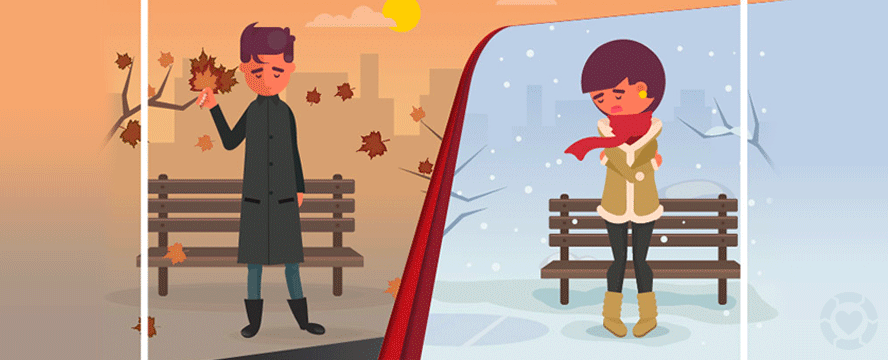
SEASONAL AFFECTIVE DISORDER

Photo by Regis College’s Online Master of Science in Nursing

Symptoms occur during particular annual seasons
(generally beginning late fall/early winter)

In a study performed by Norman Rosenthal and colleagues, an interesting pattern was discovered.5

  • Individuals living in the state of Maryland were analyzed.
  • The days became shorter in day light span as the year progressed forward.
  • During the last few months and the first few years of each year, the highest amount of depressive moods were reported.
  • This shows the impact which sunlight has on individuals in their day-to-day life.

MAJOR DEPRESSIVE DISORDER

Photo by Gratisography on Pexels.com

Symptoms persist for at least two weeks

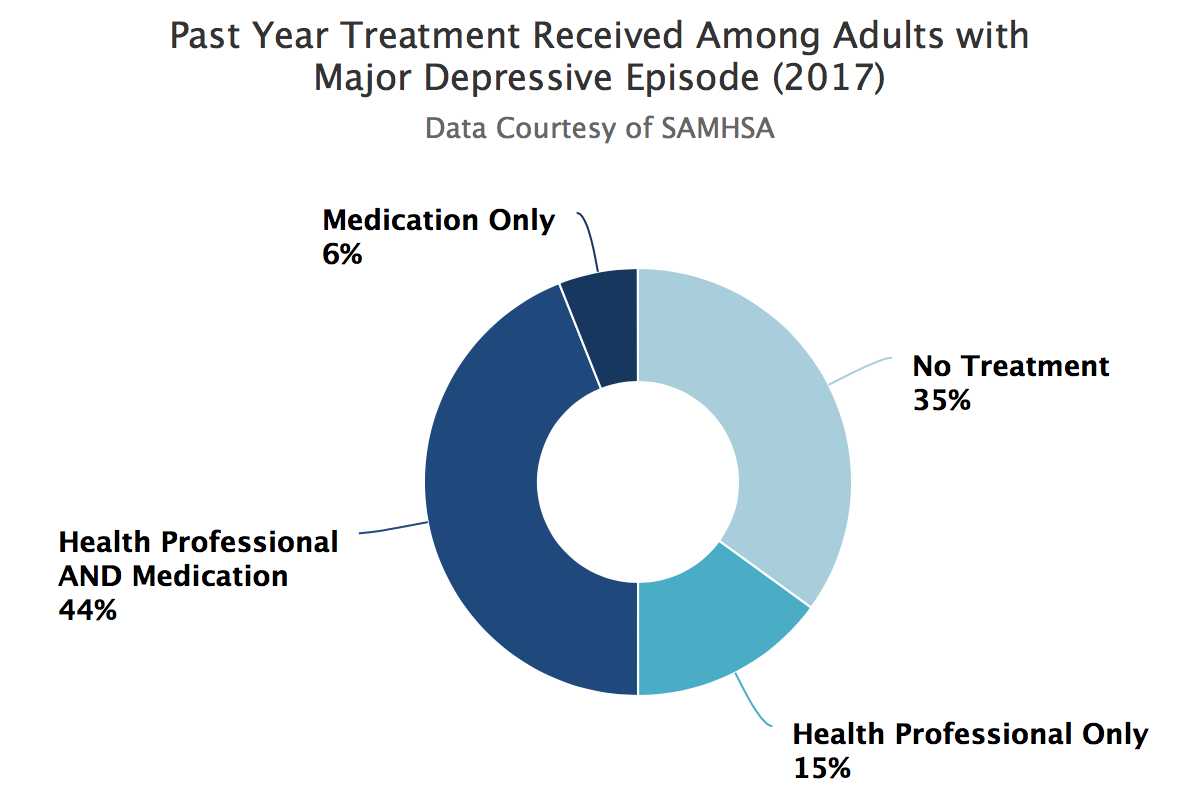
The National Institute of Mental Health gathered data on the specific treatment types used on average by individuals 18 years and older to aid in overcoming their symptoms of Major Depressive Disorder3:

  • An estimated 65% received combined care by a health professional and medication treatment.
  • Treatment with medication alone was least common (6%).
  • Approximately 35% of adults with major depressive episode did not receive treatment.

PERSISTENT DEPRESSIVE DISORDER


Photo by Jeffrey Czum from Pexels

Symptoms persist for two years or longer

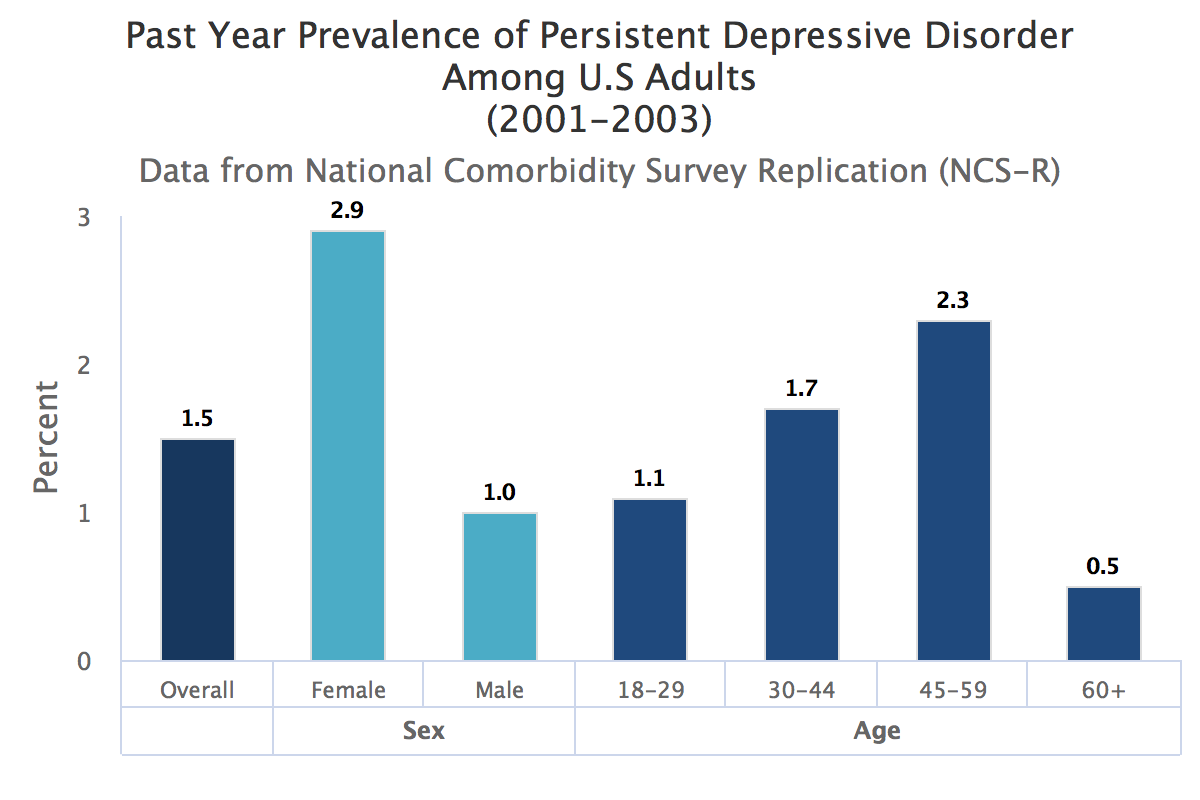
In a study done by the National Institute of Mental Help in regards to Persistent Depressive Disorder among adults (18 years or older), the following was concluded4:

  • An estimated 1.5% of U.S. adults had persistent depressive disorder in the past year.
  • Past year prevalence of persistent depressive disorder among adults higher for females (1.9%) than for males (1.0%).
  • An estimated 1.3% of U.S. adults experience persistent depressive disorder at some time in their lives.

Resources

What if I am feeling suicidal?
If you or anyone you know are feeling suicidal, please dial 9-1-1 or go to your nearest emergency room.

The National Suicide Hotline is 1-800-273-8255. If you don’t feel comfortable talking to someone over the phone, you can also visit their website at https://suicidepreventionlifeline.org/talk-to-someone-now/ and utilize their “chat with lifeline” function.


Local Hospitals:

Closest hospital to UNG Dahlonega and Gainesville
North Georgia Medical Center
743 Spring St NE
Gainesville, GA 30501
(770)219-9000

Closest hospital to UNG Cumming
Northside Hospital Forsyth
1200 Northside Forsyth Dr
Cumming, GA 30041
(770) 844-3200

Closest hospital to UNG Oconee
1201 Bishop Farms Pkwy
Watkinsville, GA 30677
(706) 310-6201


Any current UNG student can utilize the student counseling center at no charge, the cost of the counseling center is included in the tuition that you are currently paying. There is no shame in asking for help.

UNG Dahlonega Student Counseling

Stewart Success Center
Suite 246
238 Georgia Circle
Dahlonega, GA 30597

To schedule an appointment call: 706-864-1819

UNG Cumming Student Counseling

300 Aquatic Cir
Cumming, GA 30040

To schedule an appointment call: 470-239-3134

UNG Gainesville Student Counseling

Student Center
Room 115
3820 Mundy Mill Rd
Oakwood, GA 30566

To schedule an appointment call: 678-717-3660

UNG Oconee Student Counseling

Administration Building
Room 106
1201 Bishop Farms Parkway
Watkinsville, GA 30677

To schedule an appointment call: 706-310-6205


Other ways to help yourself or a friend

A    Assess for risk of suicide or harm.

If you or an the individual are is expressing suicidal thoughts or behaviors, it is vital to seek immediate medical attention in order to prevent further harm to oneself. Address the situation accordingly in order to protect yourself or the individual from causing permanent harm.

L     Listen nonjudgmentally.

Allow time for you and others to express their thoughts and feelings toward the present moment. This may require for you to be less talkative in order to allow space for your peer to express her true emotions. Try not to express your own opinions on the matter. Be a shoulder to lean on.

G    Give reassurance and information.

Provide the individual with helpful information that enables them to look in the direction of light in their life rather than darkness. Never blame the individual for the emotions they are experiencing. Choose to share resources with her in order to pursue a healthy lifestyle.

E     Encourage appropriate professional help.

Approach the individual with resources in the professional field of mental health. Seek out counselors and psychologists who are trained in treating such symptoms. This provides a stable outlet for an individual in which they are capable of experiencing growth.

E     Encourage self-help and other support strategies.

By acknowledging the plentiful resources that exist in the world, it helps an individual select which strategies truly work for herself. There are many resources including self-help books, lifestyle changes, regular exercise, and even support from one’s community.

Components to helping an individual with depression provided by Jamie Mondics.1